
If you search for triple a games, you’re looking at gaming’s biggest commercial productions. These titles usually involve major publishers, large development teams, and substantial marketing campaigns. They often aim for broad audiences across consoles and PC.
Direct answer: Triple-A, or AAA, describes large-scale video games backed by substantial development and marketing resources. The label is informal, not an official rating. AAA releases usually feature large teams, expensive production, detailed presentation, broad distribution, and strong commercial expectations.
| Quick fact | What it means |
|---|---|
| Term | AAA or Triple-A |
| Official rating? | No |
| Typical publishers | Major publishers and platform holders |
| Production scale | Large teams and substantial budgets |
| Common platforms | PlayStation, Xbox, PC, and sometimes Nintendo systems |
| Typical strengths | Visual detail, audio, cinematic presentation, scope |
| Does AAA mean better? | No, quality depends on execution |
| Common alternatives | AA and indie games |
What Are Triple A Games?

Triple-A games are major commercial video games made with significant financial and production resources. The term describes production scale more than genre or quality. No industry organization officially awards an AAA label.
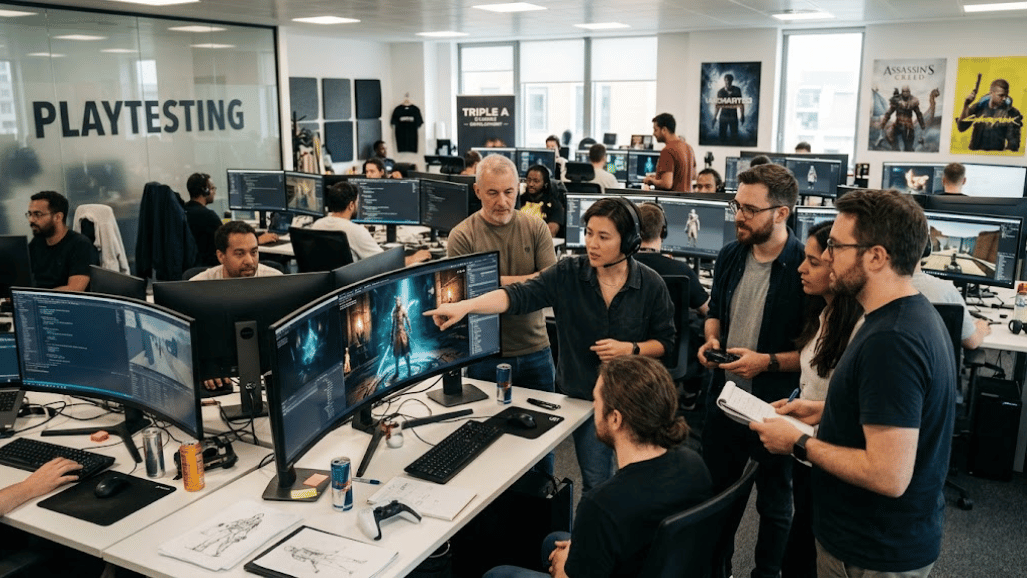
A racing game, RPG, shooter, horror title, or action-adventure can all fit the category. What matters more is the project’s size and ambition. Major releases commonly involve several studios, specialized teams, localization, testing, marketing, and long development schedules.
The label is therefore similar to calling a movie a blockbuster. It suggests substantial investment and high commercial expectations. It doesn’t guarantee players will enjoy the finished product.
What Does AAA Mean in Gaming?
AAA is pronounced “triple-A,” rather than saying each letter separately. Gaming publications use the term as shorthand for expensive, large-scale productions. The term became common as game budgets and technical ambitions grew.
The name does not represent three official standards or requirements. A developer does not complete an application to earn the classification. Publishers, journalists, developers, and players use it informally based on scale.
That distinction matters because no exact budget turns a project into AAA. One large project may cost far more than another. Team size, marketing, technology, scope, and publisher support all influence the label.
What Makes a Video Game AAA?
Large budgets are an obvious sign, but money alone doesn’t define the category. Production structure also matters because major releases contain thousands of individual creative and technical tasks. Development can involve programmers, artists, animators, writers, designers, testers, and outside contractors.
Large publishers can also fund extensive motion capture, voice acting, music, localization, and marketing. Expensive technology may support detailed environments and advanced animation. Those resources can make production values easier to notice.
Marketing is another major difference. Publishers often promote important releases through trailers, previews, partnerships, storefront advertising, and launch campaigns. That spending reflects the high sales expectations attached to expensive projects.
AAA vs. AA vs. Indie Games
The easiest way to understand these labels is to compare production models. None of them represents a formal quality score. A smaller game can earn stronger reviews than a much more expensive release.
| Category | Typical production | Publisher support | Common strengths | Common limitations |
|---|---|---|---|---|
| AAA | Large teams and major investment | Usually strong | Scale, presentation, technology | High costs and commercial pressure |
| AA | Mid-sized production | Often present | Focused scope and polished mechanics | Fewer resources than major blockbusters |
| Indie | Small or independent teams | Limited or optional | Creative freedom and experimentation | Smaller production capacity |
Indie development often gives creators more freedom to experiment with mechanics or unusual concepts. Smaller budgets can also encourage tighter scope. Techirya’s guide to standout indie games shows how strong games can succeed without blockbuster production.
AA games occupy a less precise middle area. They usually have more resources than small independent projects but less than major publisher releases. Their smaller scale can produce focused experiences without the financial pressure surrounding huge launches.
Popular Examples of AAA Titles
Grand Theft Auto V and Red Dead Redemption 2 are commonly associated with blockbuster development. God of War Ragnarök and Marvel’s Spider-Man 2 also fit the familiar model. Large Call of Duty releases provide another recognizable example.
Elden Ring shows the category doesn’t require one specific game structure. Final Fantasy entries demonstrate the same point through role-playing design and cinematic presentation. Genre alone cannot determine production tier.
These examples also show why graphical realism is not a reliable definition. Art direction can differ greatly between major productions. Funding, production scale, publisher backing, and commercial expectations provide better clues.
Why Are Major Games So Expensive to Make?
Modern game development combines many specialized disciplines. Detailed character models require artists, animators, programmers, audio engineers, testers, and technical support. Larger worlds multiply that work across environments, quests, interactions, and performance targets.
Developers must also support several hardware configurations and display settings. Console optimization creates another layer of testing. PC releases can require broader compatibility work across processors, graphics cards, drivers, and resolutions.
Marketing adds more costs before and after release. Large campaigns may include trailers, events, advertising, influencer partnerships, and retail promotion. Current industry explainers describe AAA budgets as reaching tens or hundreds of millions for major projects.
Do AAA Games Need Powerful Hardware?
Hardware requirements depend on the individual game and the settings you choose. A new blockbuster may demand substantial GPU power at high resolutions. Lower settings can make some PC releases accessible to more modest systems.
Storage is another practical concern for modern players. Large textures, audio files, cinematic assets, and downloadable updates can consume significant space. Techirya’s PS5 storage upgrade guide explains options when console storage becomes restrictive.
PC players should always check the developer’s minimum and recommended specifications. A gaming label cannot tell you whether your computer meets those requirements. Techirya also covers hardware considerations in its ASUS TUF A15 gaming laptop guide.
Does AAA Mean a Game Is Better?
No production category guarantees quality. A large budget can fund detailed animation, professional voice acting, technical systems, and extensive worlds. It cannot automatically create satisfying combat, memorable writing, or balanced progression.
Smaller teams sometimes outperform expensive projects in specific areas. They can take design risks that large publishers may consider commercially uncertain. That competition gives players more choices across different budgets.
The useful question is therefore not whether AAA is automatically better. Ask whether a particular game matches your preferred genre, playtime, platform, and features. Reviews and gameplay footage can help before you spend money.
What U.S. Players Should Check Before Buying
Start by checking the exact edition your preferred U.S. storefront offers. Standard, deluxe, and collector editions may include different content. Prices and discounts can also vary by platform and sale.
Next, review downloadable content and post-launch plans. Some releases sell expansions, cosmetic items, season passes, or other extras separately. Techirya’s DLC meaning guide explains how downloadable content works.
Finally, confirm performance on your specific hardware. PC buyers should examine system requirements and independent benchmarks. Console players should check storage needs, performance modes, and available patches.
Are Big-Budget Games Worth the Money?
Value depends on the experience, not the production label. A long open-world adventure can be worthwhile for one player and exhausting for another. A shorter, focused game can provide better value if it matches your habits.
Consider how many hours you expect to play and whether multiplayer matters. Check whether important features require extra purchases or subscriptions. Also compare current prices instead of assuming every major release costs the same.
Waiting can sometimes make sense if you are unsure. Post-launch patches may fix technical problems. Sales can also lower the cost of games available for several months.
How Triple-A Production Affects Game Design
Large budgets can encourage publishers to pursue broad audiences. Familiar franchises may appear safer because players already understand their worlds and mechanics. Expensive projects also need strong sales to recoup costs.
That pressure can influence design choices. Developers may favor recognizable genres, established intellectual property, or features with proven audience appeal. It can also encourage long-term monetization through expansions or continuing content.
Still, major budgets can support ambitious creative work. Large teams can build detailed environments, sophisticated animation, and complex technical systems. The final result depends on how effectively those resources support the game’s core ideas.
Frequently Asked Questions
What are triple-A games?
They are large-scale video games backed by substantial development and marketing resources. The AAA label is informal rather than officially awarded. It usually signals major production ambitions and high commercial expectations.
What does AAA stand for in video games?
AAA is pronounced “triple-A.” It does not expand into three separate words. The industry uses it as an informal label for production tiers.
Is AAA the highest level of gaming?
AAA usually describes the largest mainstream development tier. Terms like AAA+ sometimes appear, but they lack formal standards. These labels should not be treated as official rankings.
Are all AAA titles open-world games?
No, production scale does not determine genre. Shooters, RPGs, racing games, horror games, and linear adventures can qualify. Open-world design is common but not required.
Are indie games worse than AAA releases?
No, indie describes a development model rather than a quality level. Independent studios can produce highly acclaimed games with smaller teams. Production scale and creative quality are separate questions.
Why do large games take years to develop?
Big releases contain thousands of connected assets and systems. Teams must create, integrate, test, revise, and optimize that work. Localization, certification, marketing, and multi-platform support can further extend schedules.
The Bottom Line
AAA describes scale, resources, and commercial expectations, not guaranteed quality. That makes the label useful when setting expectations about production size. It should never replace judging an individual game on its merits.
For players, the smartest approach is simple. Check gameplay, reviews, hardware requirements, included content, and current pricing before buying. Choose the experience that fits how you play, regardless of its development tier.